

Environmental Degradation
Environmental degradation is a result of the active interaction of socioeconomic, institutional, and technical processes. Environmental degradation is a process that results in a reduction in the biological diversity and health of the environment by compromising the natural environment in some way. Environmental degradation is defined as the deterioration of the physical elements of the environment brought about by human activities to the point where it cannot be corrected by the environment’s self-regulatory systems.
This process could start out entirely naturally or it might be accelerated or triggered by human activity. Environmental deterioration is considered a severe threat to communities and planets by several international organisations. Many variables, such as economic growth, population growth, urbanisation, intensification of agriculture, increased energy consumption, and transportation, may be responsible for environmental changes. Another significant issue that contributes to environmental issues is poverty. In contrast to the problems of growth and expansion, the economics of environmental pollution, resource depletion, and resource degradation have been disregarded. Due to its significant population growth, India is also experiencing issues with environmental deterioration.
Factors that Led Environmental Degradation
There are basically two factors namely:
1. Natural factors such as drought, storms on sea, land and deserts such as hurricanes, tornadoes, carina and volcanic eruptions. These factors lead to land degradation through erosion.
2. Human factors which include deforestation, industrialization and urbanization. These factors lead to water, air and land pollution.
Types of Environmental Degradation
Types of environmental degradation:
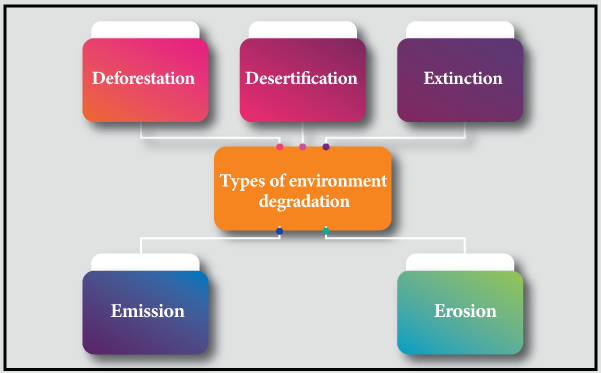
Deforestation
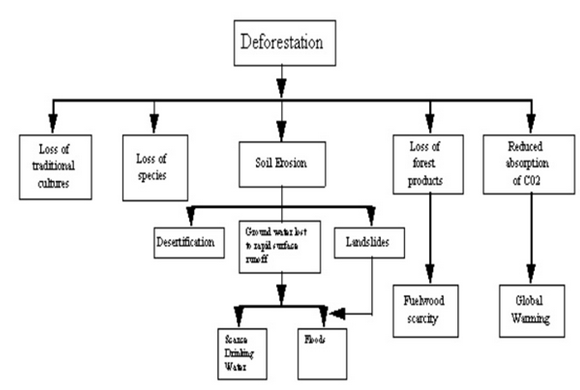
Deforestation is the process of logging and/or burning forests to remove them. Deforestation happens for a variety of causes, such as when trees or the charcoal they produce is utilised as fuel or sold as a commodity, and when cleared land is turned into pastureland for cattle, farms, and communities. Without enough regeneration, the removal of trees has harmed habitats, reduced biodiversity, and increased dryness. The bio-sequestration of atmospheric carbon dioxide is negatively impacted. Regions that have lost their forests typically experience severe unfavourable soil erosion and frequently become barren.
Causes of deforestation: There are several causes of current deforestation such as dishonesty of government institutions, the unfair distribution of wealth and power, population growth and overpopulation, and urbanization. Globalization is also major cause of deforestation, though there are cases in which the impacts of globalization have supported localized forest recuperate.
Extinction
It is the process by which a species, genus, or family, becomes extinct no longer existing and alive in the world. It is the eradication and destruction of anything that was once there in the world. It specifically refers to the termination of an evolutionary branch or line on the tree of life in the context of biology. A species’ extinction can have a profound impact on an ecosystem, as well as on the physical environment and climate, frequently resulting in other extinctions.
Desertification:
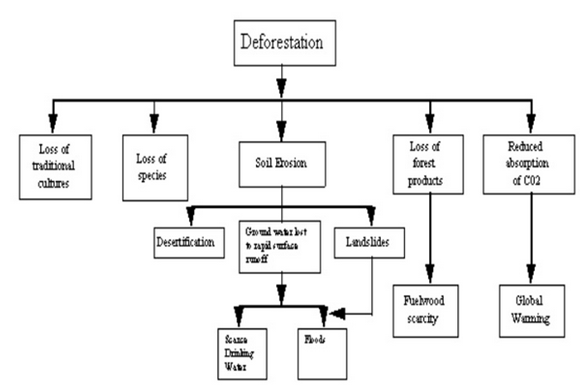
Due to a variety of factors, including climatic changes and human activity, desertification is the destruction of land in waterless and dry sub-humid environments. The main cause of desertification is human activity. It is mostly brought on by overgrazing, excessive groundwater withdrawal, and the diversion of river water for industrial and human usage. All of these processes are ultimately fueled by overpopulation. Reduced biodiversity and impaired productivity are the primary effects of desertification, as seen in the conversion of shrub-dominated land to non-native grasslands.
Causes of desertification:
Desertification occurs due to numerous factors, primarily anthropogenic causes, which began in the Holocene era and continues today. The primary reasons for desertification are overgrazing, over-cultivation, increased fire frequency, water impoundment, deforestation, over drafting of groundwater, increased soil salinity, and global climate change.
Multilevel set of causes of Desertification
Emission
Emission is a process when chemicals or other materials are released into the environment by humans or natural factors. Pollution is created through emission, which is what happens when chemicals are discharged into the atmosphere. Emissions come from numerous natural processes. A volcano’s eruption releases ash, acid, and numerous hazardous gases. Forest fires cause the production of carbon dioxide, dioxins, carcinogenic compounds, smoke, and soot.
Erosion
Erosion is the process of weathering and transporting solids from their source or the natural environment and depositing them elsewhere. Erosion typically happens as a result of soil and other materials being transported by wind, water, or ice, creeping down slopes under the force of gravity, or, in the case of bio-erosion, by living organisms like burrowing mammals.
A certain amount of erosion is natural and, it is good for the ecosystem. Erosion is different from weathering, which is the process of chemical or physical breakdown of the minerals in the rocks, although the two processes may occur simultaneously.
Causes of environmental degradation
Environmental conditions deteriorated and had an effect on human health as a result of increased human activity and the emission of hazardous chemicals. The reasons of environmental degradation are numerous. Rapid urbanisation and industrialization, agricultural expansion and intensification, and the eradication of natural habitats are all effects of the nation’s rapid population increase and economic development on the environment. The population is expanding at an unprecedented rate in India, which is negatively harming the environment and natural resources.
The increasing population and the environmental deterioration face the challenge of continued development without environmental damage. Population impacts on the environment is mainly through the use of natural resources and production of wastes and is related with environmental stresses like loss of biodiversity, air and water pollution and increased pressure on arable land.
Environmentalists have also cited poverty as a significant factor in environmental degradation. A very complicated phenomena is the revolving relationship between poverty and the environment. Because the poor rely more on natural resources than the rich, they may use up such resources more quickly due to inequality because they have less chance of accessing other resources. Additionally, a deteriorated environment might expedite the process of destitution, again because the poor depend directly on natural assets.
It has been observed that poor people migrate to urban areas due to lack of opportunities for profitable employment in villages and the ecological stresses. Extra-large cities are emerging and urban slums are expanding. Such rapid and unplanned development of cities has resulted in ruin of the urban environment. It has broadened the gap between demand and supply of infrastructural services such as energy, housing, transport, communication, education, water supply and sewerage and recreational amenities, thus depleting the valuable environmental resource base of the cities. The result is the growing trend in worsening of air and water quality, generation of wastes, the proliferation of slums and undesirable land use changes, all of which contribute to urban poverty.
There are some economic factors that lead to environmental degradation. Environmental degradation is the consequence of market failure, that is, the non-existent or poorly functioning markets for environmental goods and services. In this framework, environmental degradation is a particular case of consumption or production externalities reflected by divergence between private and social costs (or benefits). Market misrepresentations created by price controls and subsidies may exacerbate the achievement of environmental objectives.
Transport activities have intense effects on the environment such as air pollution, noise from road traffic and oil spills from marine shipping. Transport infrastructure in India has expanded significantly in terms of network and services. Thus, road transport accounts for a major share of air pollution load in cities such as Delhi. Port and harbour projects mainly impact on sensitive coastal ecosystems. Their construction affects hydrology, surface water quality, fisheries, coral reefs and mangroves to varying degrees.
Effect of agricultural development on the environment stems from farming activities which contribute to soil erosion, land salinization and loss of nutrients.
Effects of Environmental Degradation
1. Impact on Human Health:
Human health is greatly impacted by environmental degradation. Areas exposed to toxic air pollutants can cause respiratory problems like pneumonia and asthma. Most people lose their lives due to indirect effects of air pollution.
2. Loss of Biodiversity:
In order to maintain ecosystem balance, biodiversity must fight pollution, replenish nutrients, safeguard water sources, and stabilise the climate. A few of the main reasons for biodiversity loss include deforestation, global warming, population growth, and pollution.
3. Ozone Layer Depletion:
Ozone layer is responsible to shield earth from detrimental ultraviolet rays. The presence of chlorofluorocarbons, hydro chlorofluorocarbons in the atmosphere is causing the ozone layer to deplete. As it will deplete, it will emit harmful radiation back to the earth.
4. Loss for Tourism Industry:
Speedy activities of tourism industry is also responsible for the worsening of the environment that relies on tourists for their daily livelihood. Environmental damage in the form of loss of green cover, loss of biodiversity, huge landfills, increased air and water pollution can be a big turn off for most of the travelers.
5. Economic Impact:
The huge cost that a nation may have to bear due to environmental degradation can have a huge economic impact in terms of restoration of green cover, cleaning up of landfills and protection of endangered species. The economic impact can also be in terms of loss of tourism industry.
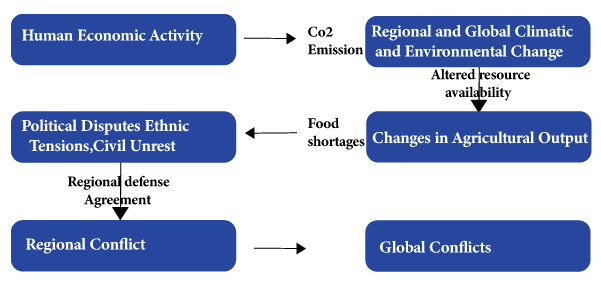
The possibility of human economic activity causing regional and global conflicts is particularly high as a result of the release of hazardous gases into the atmosphere (environmental degradation), which changes agricultural production and makes resources inaccessible, ultimately resulting in food shortages.
Impact of environmental degradation
In conclusion, pollution results from the release of dangerous substances or goods into the environment. There are many different types of environmental contamination, including soil, air, water, and land pollution. The collapse of the earth or worsening of the environment due to the consumption of resources such as air, water, and soil, the loss of ecosystems, and the extinction of wildlife is known as environmental degradation.
0 Comments